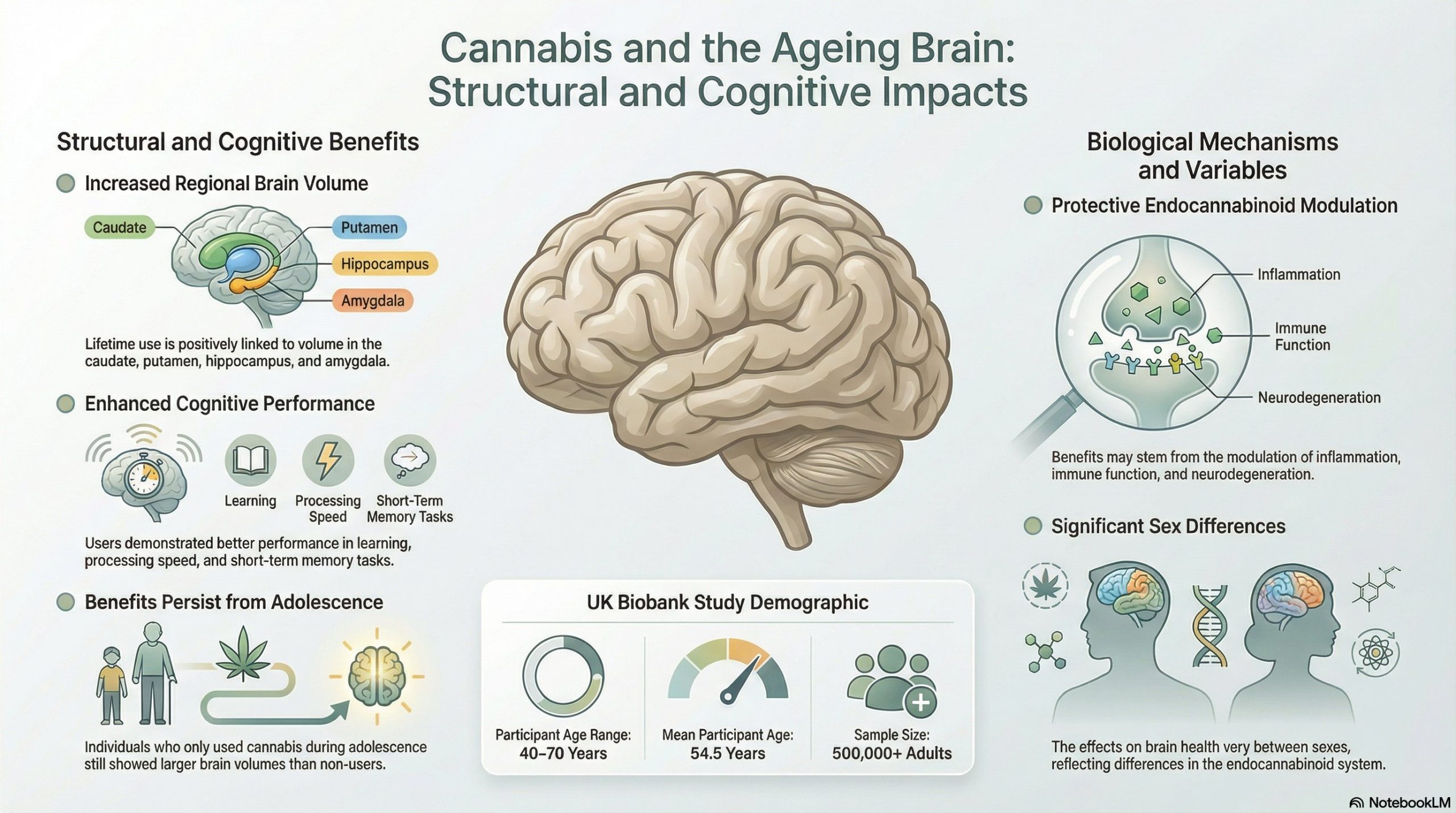
For decades, mainstream neuroscience held an immovable premise: cannabis use was synonymous with cognitive decline and gray matter reduction. However, a massive study recently published in the Journal of Studies on Alcohol and Drugs—and highlighted by Neuroscience News—has sent shockwaves through the medical community.
Research led by the University of Colorado suggests that in middle-aged and older adults, lifetime cannabis use is not only unrelated to brain damage but is actually linked to larger brain volumes and superior cognitive function.
The Anatomy of Resilience: CB1-Dense Regions
The study analyzed data from over 25,000 participants in the UK Biobank, one of the world’s most rigorous biomedical databases. Researchers focused on brain areas with the highest density of Type 1 Cannabinoid (CB1) receptors—the molecular “docking stations” where compounds like THC and CBD exert their influence.
The results revealed a significant positive correlation in critical structures:
- The Hippocampus: Essential for memory consolidation and spatial navigation. This is typically the first region to atrophy in Alzheimer’s patients.
- The Amygdala: The hub for emotional processing and stress response.
- The Striatum (Caudate and Putamen): Areas responsible for habit formation, movement, and the reward system.
Unlike the control group (non-users), those with a history of cannabis use showed remarkable preservation of volume in these areas, directly challenging the “shrunken brain” narrative.
Cognitive Performance: Faster and Sharper
The most provocative aspect of the study is the disconnect between social stigma and neuropsychological reality. Participants with higher lifetime cannabis exposure consistently scored higher in:
- Processing Speed: The ability to absorb information and react efficiently.
- Working Memory and Learning: An enhanced capacity to retain new data and apply it in real-time.
Crucially, these benefits were observed even in individuals who used cannabis exclusively during their youth (adolescence and early 20s) and then ceased use. This suggests a potential latent neuroprotective effect or a neural “scaffolding” that better resists the passage of time.
The Mechanism: Inflammation vs. Stimulation
How can a substance traditionally labeled a “toxin” result in a more robust brain? Scientists propose two primary hypotheses:
- Anti-inflammatory Properties: Brain aging is driven by “inflammaging”—chronic, low-grade systemic inflammation. Cannabinoids may act as a shield, reducing oxidative stress on neurons.
- Endocannabinoid System (ECS) Modulation: Cannabis may “exercise” the ECS, maintaining cerebral homeostasis (balance) during a period when the body’s natural functions begin to decline.
Future Implications for OzhTimes Readers
For our audience, this discovery marks a turning point in bioethics and human optimization. This is not an invitation for indiscriminate use—the study emphasizes the importance of dosage and individual biology—but it is a demand for scientific re-evaluation.
We are entering an era where cannabis may transition from a recreational drug to a longevity agent. If brain volume is an indicator of “cognitive reserve,” cannabis could be writing a new chapter in the global fight against dementia and cognitive decline.